Dental implant vs. bridge: Which is better for a missing tooth?
If you are missing a tooth, deciding to replace it may feel like the easy part. The harder question is often how to replace it.
At Shoreside Dentistry, one of the questions we hear often is, “Should I get a dental implant or a bridge?” Both options can restore a missing tooth, help you chew comfortably, and complete your smile, but they work in very different ways.
For most patients, one treatment is not automatically better than the other. The right choice depends on the health of the surrounding teeth, your timeline, budget, bone health, and what you feel most comfortable with.
That is why Dr. Macy takes time to educate our Tampa, FL patients about both options before recommending a treatment plan. We want you to understand what an implant involves, what a bridge involves, and the advantages and tradeoffs of each so you can make an informed decision.
What is a dental implant?
A dental implant replaces a missing tooth without relying on the teeth next to it for support.
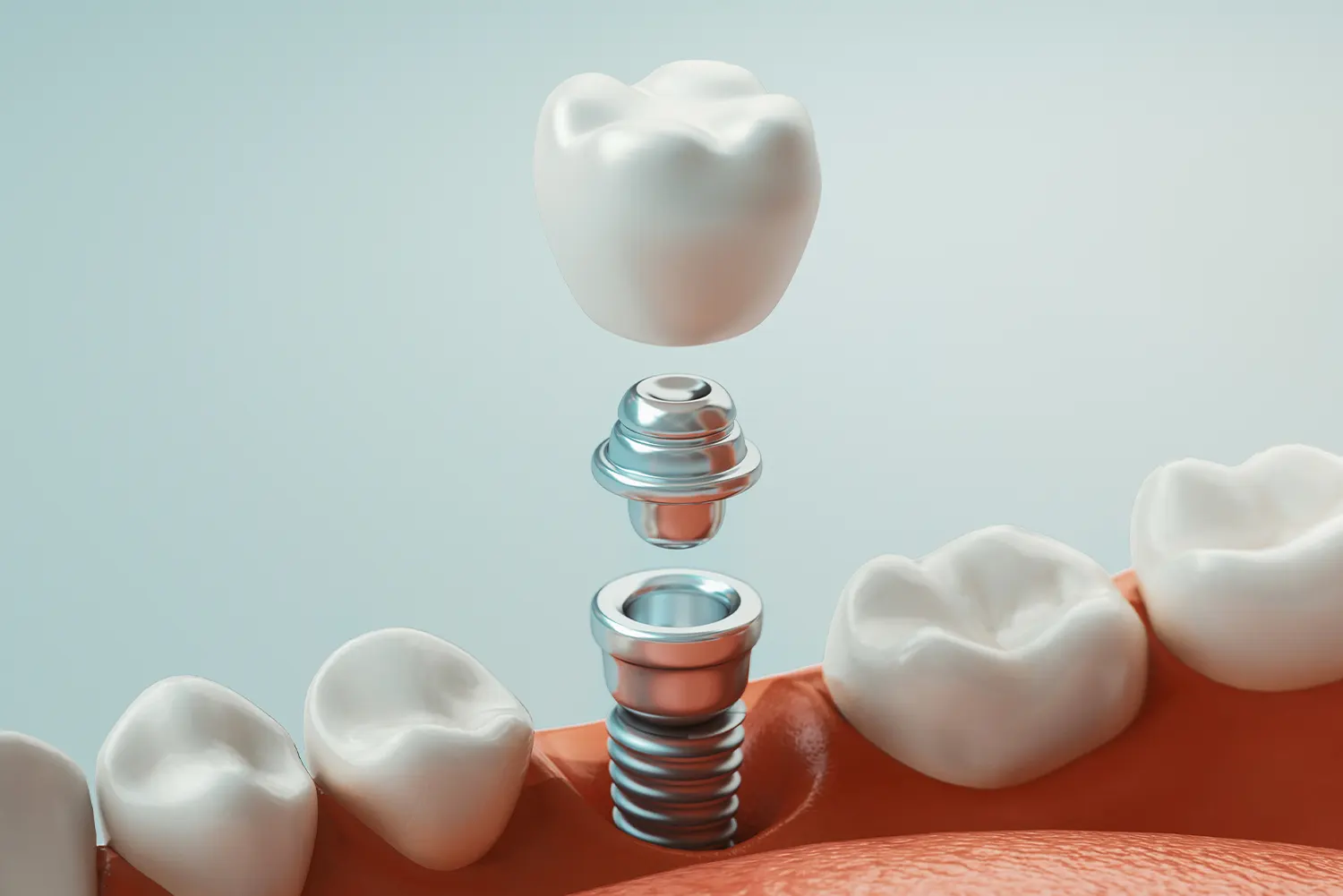
The implant itself is a small post that is surgically placed into the jawbone where the tooth root used to be. After the area heals, the implant is restored with a dental crown that recreates the visible portion of the missing tooth.
One of the biggest advantages of an implant is that it stands independently. We generally do not need to reshape the neighboring teeth simply to replace the tooth that is missing.
That can be especially valuable when the teeth on either side of the space are healthy and have never needed crowns.
The tradeoff is time. Dental implants usually require a longer treatment process because the implant needs time to heal before the final restoration is completed. Depending on your individual situation, additional procedures may also be needed.
What is a dental bridge?
A traditional dental bridge replaces a missing tooth by using the neighboring teeth for support.
The teeth on either side of the empty space are prepared for crowns. Those crowns are connected to a replacement tooth in the middle, creating one continuous restoration that “bridges” the gap.
Unlike a dental implant, a bridge does not require implant surgery or the same healing period. Because of that, the process is usually much faster and can often be completed within a few weeks.
A bridge can also be a very practical option when the teeth surrounding the missing tooth already need dental work. If those teeth already have crowns, large fillings, or areas of decay, using them as part of a bridge may make a lot of sense.
Dental implant vs. bridge: What are the biggest differences?
When Dr. Macy talks with patients at Shoreside Dentistry about choosing between a dental implant and a bridge, two of the first considerations are usually time and cost.
There are a few other important differences to think about as well.
Treatment time
A dental implant typically takes longer from start to finish.
The implant needs to be placed surgically, and the area needs time to heal before the final crown can be attached. Your exact timeline will depend on your oral health, bone, location of the tooth, and whether any additional procedures are necessary.
A dental bridge is generally much faster because it does not require the same surgical healing period. For someone who wants to replace a missing tooth sooner, that can be an important difference.
Cost
Dental implants generally involve a higher upfront investment than a traditional bridge.
There are several components involved in implant treatment, and additional procedures can increase the overall cost.
A bridge is often less expensive initially. However, we do not recommend making the decision based on price alone. The health of your surrounding teeth, long-term needs, and treatment preferences all matter.
What happens to the neighboring teeth?
This is one of the most important differences.
A dental implant is independent. If the teeth next to the missing space are completely healthy, we can generally leave them alone.
A traditional bridge works differently. The teeth on both sides of the space must be reshaped so they can support crowns that hold the bridge in place.
If you have two perfectly healthy teeth beside the missing tooth, you may prefer an implant because it allows us to preserve those natural teeth.
On the other hand, if the neighboring teeth already have large restorations, cavities, or crowns, a bridge may be a very logical solution.
When might a dental implant make more sense?
We may recommend considering a dental implant when the teeth surrounding the missing space are healthy and we would prefer not to alter them.
An implant may be worth considering if:
- The neighboring teeth are healthy and have never needed crowns.
- You want a restoration that stands independently.
- You are comfortable with a longer treatment timeline.
- You are comfortable undergoing implant surgery.
- Your bone and oral health make implant placement appropriate.
- You want to clean around the restoration more similarly to a natural tooth.
An examination and appropriate X-rays are necessary before we can determine whether an implant is a good option for you.
When might a dental bridge make more sense?
There are also many situations in which a bridge may be the better fit.
One of the clearest examples is when the teeth surrounding the missing space already need restorative treatment.
A bridge may also appeal to patients who:
- Want to replace the tooth more quickly.
- Prefer to avoid implant surgery.
- Are looking for a lower initial treatment cost.
- Are not ideal candidates for an implant.
- Have adjacent teeth that could benefit from crowns.
We do not view a dental bridge as simply the “cheaper version” of an implant. In the right situation, it can be an excellent and appropriate restorative treatment.
What does an implant or bridge feel like?
Patients sometimes worry that one option will feel noticeably more artificial than the other.
Functionally, both dental implants and bridges are designed to restore your ability to chew comfortably. Once treatment is complete and you have adjusted to your restoration, you may not notice a major difference during normal eating.
Where patients tend to notice more of a difference is in how the restoration is cleaned.
How do you clean an implant compared with a bridge?
A single dental implant can generally be cleaned much like an individual tooth. You can brush around the restoration and floss along the sides as part of your normal oral hygiene routine.
A bridge requires a slightly different approach.
Because the replacement tooth and supporting crowns are connected as one piece, you cannot floss between them the same way you would between individual teeth. Instead, you need to clean underneath the bridge.
We may recommend tools such as:
- A floss threader
- Specialized bridge floss
- Interdental cleaning tools
- A water flosser
There may be a small learning curve at first, but once you know how to clean your bridge, it can become a normal part of your routine.
What are the tradeoffs of each option?
With a traditional bridge, the biggest consideration is that we have to alter the neighboring teeth.
If those teeth already need crowns, that may not be a major drawback. If they are completely healthy, it becomes an important part of the decision.
With a dental implant, the biggest consideration is surgery and healing time.
The implant is placed into the jawbone, and certain situations may make treatment more involved. Bone volume, the location of the missing tooth, and other clinical factors can affect the treatment plan. Some patients may also need additional procedures before an implant can be placed.
Neither treatment is completely one-size-fits-all, which is why a consultation is so important.
Which lasts longer: a dental implant or a bridge?
Both dental implants and bridges can provide strong long-term results when they are appropriately selected, properly maintained, and supported by good oral health.
Longevity depends on several factors, including:
- Oral hygiene
- Gum health
- The health of the supporting teeth and bone
- Your bite
- Grinding or clenching habits
- Regular dental care
Rather than making blanket promises about exactly how long a restoration will last, Dr. Macy focuses on choosing the treatment that makes the most sense for your oral health and helping you maintain it over time.
Is a dental implant better than a bridge?
This is the question everyone wants a simple answer to, but the answer really is: it depends.
If the teeth surrounding your missing tooth are completely healthy, an implant may allow us to replace the tooth without altering them.
If those neighboring teeth already need crowns, a bridge may be a very efficient and sensible solution.
If your priority is completing treatment quickly, you may lean toward a bridge. If preserving untouched neighboring teeth is more important to you and you are comfortable with a longer process, an implant may be more appealing.
Your bone health, oral health, budget, treatment goals, and personal preferences all influence the decision.
How do we help you choose between an implant and a bridge?
When you visit Shoreside Dentistry in Tampa, FL for a missing tooth, we start by gathering the information we need to give you a thoughtful recommendation.
Step 1: We examine the area
We look closely at the missing tooth space, neighboring teeth, gums, and surrounding structures. We also take appropriate X-rays so Dr. Macy can understand what is happening beneath the surface.
This helps us determine whether the neighboring teeth are healthy, whether they already need crowns, and whether an implant is appropriate for the area.
Step 2: We walk through both options
Once we understand your clinical situation, we explain what treatment would actually look like.
We can discuss the process, timeline, relative cost, any additional treatment that may be needed, and how each option would affect the surrounding teeth.
Once the differences are clear, patients often have a much stronger sense of which direction feels right for them.
Step 3: We make the decision together
Our role is not to pressure you toward one treatment.
Our role is to help you understand what we see, explain the advantages and tradeoffs, and recommend treatment based on your oral health.
Your priorities matter too. If you are concerned about treatment time, surgery, cost, or preserving healthy teeth, we want to know.
Frequently asked questions about dental implants vs. bridges
Is a dental bridge faster than an implant?
In most cases, yes. A bridge can generally be completed sooner because it does not require surgical implant placement and a healing period.
Do you have to reshape healthy teeth for a dental bridge?
A traditional bridge requires the teeth on either side of the missing space to be prepared for crowns. If those teeth are completely healthy, this is an important factor to consider.
Is dental implant placement surgery?
Yes. A dental implant is surgically placed into the jawbone. Before recommending treatment, we evaluate the area and explain what the procedure would involve in your individual case.
Can I floss around a dental bridge?
You need to clean underneath a bridge rather than floss between the connected portions like individual teeth. A floss threader, specialized floss, or water flosser can help.
Can I chew normally with a dental implant or bridge?
Both are designed to restore comfortable chewing function once treatment and any necessary healing are complete.
What if the teeth next to my missing tooth already have crowns?
That may make a bridge particularly worth considering. Dr. Macy can evaluate those teeth and determine whether using them to support a bridge makes sense for your situation.
How do I know if I am a candidate for a dental implant?
The best way to know is through an examination. We evaluate the missing tooth site, surrounding teeth, gums, bone, and other clinical factors before determining whether implant treatment is appropriate.
Missing a tooth in Tampa? Let’s talk about your options
There is no universal winner when comparing a dental implant and a bridge.
Sometimes an implant makes the most sense because it allows us to leave healthy neighboring teeth untouched. In other situations, a bridge may be the better fit because the teeth beside the space already need crowns, the patient wants a faster treatment process, or other clinical factors make a bridge more practical.
What matters most is understanding the difference before making your decision.
If you are missing a tooth in Tampa, FL and are not sure whether a dental implant or bridge is right for you, we invite you to visit us at Shoreside Dentistry. Dr. Macy can examine the area, review your X-rays, and walk you through your options so you can move forward feeling informed and confident about your care.
Call Shoreside Dentistry at (813) 482-3847 to schedule a consultation.
Related Posts
How Do Regular Cleanings Prevent the Need for Root Canals?

What counts as a dental emergency? When to call an emergency dentist
Dental implant vs. bridge: Which is better for a missing tooth?